Tuesday, April 28, 2009

David Cronenberg: Auteur (Part One)

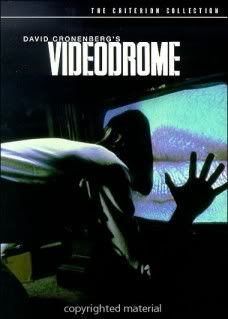
So it's official, Universal is going to remake David Cronenberg's Videodrome and make it into "a large-scale sci-fi action thriller". Ugh. Is it really coming to this? This is like trying to remake Rocky Horror Picture Show or Harold & Maude or Eraserhead. They aren't stories to be re-worked, they are iconic cult classics that rely on their look, feel, the actors who played the parts, and the directors who created something unique and temporal. As an auteur, Cronenberg's work feels especially untouchable in my opinion. All of his films certainly have their flaws but they each are very special and hold a significant place within his overall body of work. For shame, Universal, for shame! I shake my fist at you!


With that said, this week starts a multi-part series on Cronenberg as Auteur. Enjoy!

David Cronenberg: Auteur

“There’s a lot of mythology about what a director must be
and the qualities that he must have and I think it’s all mythology. In fact, each person invents himself or herself as a director in a very intimate and specific and unique way.”

- David Cronenberg (Rabid commentary 34:05)
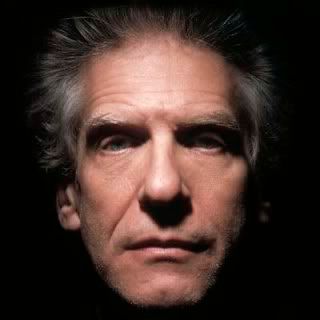
In the world of film, an auteur is a director who can for all intents and purposes, be considered the author of the piece he directs. The drama that plays out on the screen embodies the vision held by the director and conveys the message intended through the choices made by the director. This is often a difficult task to accomplish within the Hollywood system where story and final product are often dictated by the studios providing the funding. David Cronenberg is one director who has managed to successfully retain his identity as an auteur throughout his career in independent filmmaking while occasionally crossing over into the Hollywood limelight.

Beginning with his first feature-length film, Shivers, Cronenberg established areas of personal interest and has consistently explored and re-explored common themes of “body horror”, technology as relating to the body, identity and alienation. Not only does Cronenberg return again and again to the same issues and concerns, in doing so, he is perpetually developing and refining his approach to the subject matter. While celebrating moderate success within the confines of Hollywood, as an auteur, Cronenberg has managed to preserve the execution of his vision through his work.

Before continuing with this study of David Cronenberg, it is important to clarify what is truly meant by the term auteur. In American film criticism, the concept of the auteur comes from auteur theory as introduced by film critic Andrew Sarris in the early 1960s. According to Sarris, auteur theory is the approach by which the entire body of work by a director must be taken under consideration in order to understand an individual film as it will be found that “after a given number of films, a pattern is established.”(Sarris/"Perils" 28) It follows that in order to be a true auteur, “over a group of films, a director must exhibit certain recurrent characteristics of style, which serve as his signature. The way a film looks and moves should have some relationship to the way a director thinks and feels.”(Sarris/"Notes" 516)

David Cronenberg can absolutely be considered a true auteur by Sarris’s definition. When looking at his complete filmography, certain patterns emerge in respect to theme as well as the look, tone and feel of Cronenberg’s pictures. This study will not cover every aspect of these patterns but will focus in on some of the more prominent, recurring themes and approaches that have come to define Cronenberg as a director and auteur.

As he himself acknowledges, Cronenberg’s films tend to be very body-conscious with the narrative often firmly imbedded within the body. “I gradually realized that I was more interested in things that happen inside you…to a certain extent, it’s your own body that’s the monster.”(Fear 11:16) In the book Cronenberg on Cronenberg, he discusses the fact that we are always trying to prepare ourselves for that which is inevitable but because certain inevitabilities are deemed taboo within our society, we find alternative ways to discuss and face these issues. “One of the ways man has always done this is through art. The cinema is one way we can do that. We confront things in a relatively safe context.”(73) With this is mind, Cronenberg began his exploration of the body through our fear of disease, aging and dying.
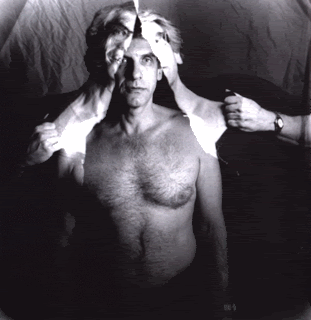
To be continued...

Monday, April 13, 2009

Marilyn Chambers, we hardly knew ye...

Well, that's not quite true. We knew Marilyn Chambers, if you know what I mean. Wink, wink, nudge, nudge.

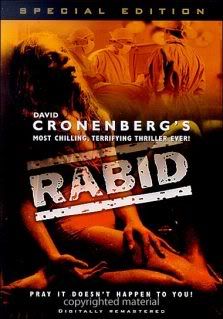
All silliness aside, I have to say I was a little sad to hear that Ms. Chambers died yesterday at the age of 56, cause currently unknown. While best known for her work in the adult film industry, Marilyn Chambers also played the lead role in the Cronenberg oldie but goodie Rabid. Where else can you get a blood-thirsty armpit monster that turns unsuspecting Canadians into ravenous zombies, eh? Sadly, Chambers' solid performance did not pave the way for a bright future in mainstream cinema but I will be forever grateful that she gave me Rabid.

Sunday, April 12, 2009

Happy Zombie Jesus Day!

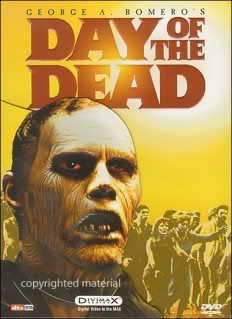
While Jesus never ate the brains of His followers, He does ask that all good Christians eat of his flesh and drink of his blood. This can only lead me to surmise that the son of God was the true origin of the modern day zombie mythology, we just got some of the details mixed up along the way. So today, in honor of the most spectacular raising of the dead since Lazarus of Bethany, I will be watching my own personal favorite zombie film, Day of the Dead.


Now for all you purists out there, I will readily admit that Night of the Living Dead and Dawn of the Dead are technically better films and certainly hold far more historical significance for the genre. But the truth is, I just have more fun when I watch Day.

Just to name a few favorites other than the aforementioned Romero staple of three:

Zombie 2 (1979)
Re-Animator (1985)
Carnival of Souls (1962)
Return of the Living Dead (1985)
Dead & Buried (1981)

And just for fun:

Shaun of the Dead (2004)
My Boyfriend's Back (1993)
Fido (2006)

What are some of your favorite zombie flicks? Which ones do you hate? Weigh in with your opinions!

Saturday, April 11, 2009

Lat den ratte komma in/Let the Right One In (2008)


Director: Tomas Alfredson
Writer: John Ajvide Lindqvist (based on novel by John Ajvide Lindqvist)
Actors: Kare Hedebrant, Lina Leandersson

Rating: 3 1/2 Black Sheep

In a year when vampires are enjoying a renewed place in the spotlight sadly thanks to such Hollywood fare as Twilight (grossed close to $200 million in the US so far), another vampire film has quietly made quite the impression on more discerning viewers. Let the Right One In is a phenomenal new Swedish film that is a must see for just about anyone.

Oskar is a 12 year old loner who seems to have trouble making friends, let alone keeping out of the path of the bullies who torment him daily. Everything changes when he meets Eli, a mysterious girl who moves into his apartment building in the middle of the night. The two children connect through their mutual loneliness but it doesn’t take long for Oskar to realize that Eli is hiding a sinister secret.

Let the Right One In
is not a horror movie, at least not in the traditional sense. It is a darkly bittersweet drama with horror elements that takes on the vampire mythology from a fresh if chilly perspective. The film is set in the dead of winter and the ever snow white setting lends a feeling of numbing emptiness that complements the story in all the right ways. The plot is character-driven with brief moments of brutality that are over almost as soon as they begin. You feel for these children even as you realize that their moral compasses may be diseased.

The cinematography in Let the Right One In is interesting and deliberate. The camera is not merely there to relay a story but to manipulate every step of the telling. On several occasions, the focus sharply zeroes in on the one stationary subject in the frame while all the action of interest remains blurred in the background where the viewer has to make assumptions about what is actually happening. I found myself almost frustrated that I wasn’t able to look at what was really taking place but at the same time, it forced me to be all the more conscious of the choices being made in the telling of the story.

The only thing that keeps me from giving Let the Right One In a top rating of four black sheep is one solitary scene. For the majority of the film, the special effects are subtle but disturbingly effective, giving the viewer just enough to understand the gravity of what is happening. For reasons I can’t possibly fathom, there is a scene where CGI is grossly and comically overused to the point of distraction. You’ll know what I’m talking about when you see the movie and in my mind it is a tragic besmirching of great filmmaking. The fact that this is such an excellent film makes it all the more sad.

There you have it. Now go out and rent this one or even buy it; you won’t be sorry!

Now on to my news: I am in the planning process for a podcast that will be available for what I hope will be your listening pleasure sometime mid to late summer of this year. I will have a co-host and we will be discussing movies, movies, and more movies that fit under the general category of genre/cult/outside-the-mainstream. I have a lot of ideas for the different segments that will be featured but I’m still in the brainstorming stage, so if you have any suggestions, please feel free to comment. Most likely the name will be The CineFiles of Citizen Irene or something similar and once the podcast launches, it will replace this blog. I will keep you posted and please, please send your comments my way!

15 Reasons Not To Leave Your House: Part Three

I bypassed the ratings for these films as they are more general recommendations than full reviews. I'm sure I will return to some of them at a later date for a more in-depth analysis. Enjoy!

Fade To Black (1980)


Director: Vernon Zimmerman
Writer: Vernon Zimmerman
Actors: Dennis Christopher, Tim Thomerson, Linda Kerridge

Fade to Black is a dark journey through the world of cinema that is best enjoyed by viewers who have a deep appreciation for old classics but don’t mind a little slashing mixed in. Dennis Christopher plays Eric Binford, a young misfit whose obsession with the early days of Hollywood leads him to do bad, bad things. This is one of those movies that is deliberately paced and quite possibly might not be your cup of tea, but if you are open to it, Fade to Black is a rich cornucopia of twisted nods to a lost era. Me likey.

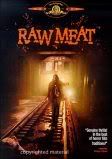
Raw Meat (1972)


Director: Gary Sherman
Writers: Ceri Jones, Gary Sherman
Actors: Donald Pleasence, Norman Rossington, David Ladd

Dead & Buried’s Gary Sherman first came out with this lesser entry into the horror genre. The basic premise is that decades ago, a group of miners carving out the tube tunnels in England were trapped in a cave-in and left to die. They survived in their giant tomb by way of cannibalism and procreation and now their ancestors continue to claim victims who make the mistake of dilly dallying late at night in the Russell Square station. The plot holes are aplenty and the creepy gross cannibal dude is shown far too much for my taste but still, Raw Meat has some redeeming factors. Actually, one redeeming factor, Donald Pleasence. Pleasence is at his brilliant best as Inspector Calhoun, a wise cracking, snarky copper who has a meandering way of figuring everything out just in the nick of time. If you are a Pleasence fan, you will not be disappointed!

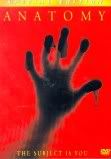
Anatomie/Anatomy (2000)


Director: Stefan Ruzowitzky
Writer: Stefan Ruzowitzky
Actors: Franka Potente, Benno Furmann, Anna Loos, Sebastian Blomberg

I have to say, Anatomie gets a bad rap. I did some digging around on the old IMDB message boards and I think I may have an answer for that. It appears that many viewers who have seen Anatomie, have had the misfortune of watching a dubbed version of the film which apparently is quite terrible. I haven’t seen this version, but from what I gather, the dialog is wretched and causes the acting to come across as fairly dismal. This is why I almost always insist that you watch a film in its original language if at all possible! This is a really fun German film starring Franka Potente of Run, Lola, Run fame and she gives a fine performance here. Potente plays young Paula Henning who is following in her grandfather’s footsteps by attending Heidelberg medical school, a highly prestigious and exclusive institution. Upon her arrival, Paula begins to realize that there are also some highly unethical practices going on behind closed doors and she doesn’t hesitate to uncover them, as long as she doesn’t get herself killed first. This flick has some amazing effects that if you’ve ever seen the Body Worlds display, you won’t believe these ones aren’t real.

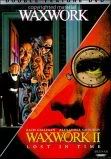
Waxwork (1988)


Director: Anthony Hickox
Writer: Anthony Hickox
Actors: Zach Galligan, Deborah Foreman, Michelle Johnson, Dana Ashbrook

Waxwork brings me fondly back to my childhood as I was in the eighth grade the first time I saw it. I loved it then and I love it still. It is a campy lark through every Halloween monster you can think of as a group of college students explore the new wax museum in their neighborhood. What they don’t know is that the ageless owner needs a different soul for each display so that he can open a portal to hell and destroy life on earth as we know it. One by one the students are sucked into the world of wax, from Dracula to the Marquis de Sade. Two of them, Mark (Galligan of Gremlins) and Sarah (Foreman) narrowly escape their fate but then must fight to save the world. This movie is a really fun ride for Halloween, a little gory and definitely silly but good stuff. The sequel, Waxwork II is also a good one and spotlights a cameo by camp god, Bruce “Ash” Campbell.

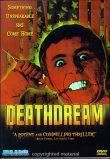
Deathdream (1974)


Director: Bob Clark
Writer: Alan Ormsby
Actors: Richard Backus, John Marley, Lynn Carlin

I think Deathdream is especially relevant to the current situation in Iraq and many Americans’ disapproval over how foreign affairs have been handled as of late. It follows a young soldier, Andy, who is killed in Vietnam and yet manages to return home sort of alive, but not. He’s not exactly a zombie or a vampire, at least not in the modern sense, but something is certainly very wrong with Andy. A slow paced but thrilling ride from director Bob Clark of A Christmas Story back in his good old horror days, Deathdream is a curious look at war and its effect not only on the individuals who live and die for our country, but also on the families they leave behind.

15 Reasons Not To Leave Your House: Part Two

I bypassed the ratings for these films as they are more general recommendations than full reviews. I'm sure I will return to some of them at a later date for a more in-depth analysis. Enjoy!

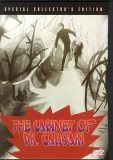
The Cabinet of Dr. Caligari (1920)


Director: Robert Wiene
Writers: Hans Janowitz, Carl Mayer
Actors: Werner Krauss, Conrad Veidt, Friedrich Feher, Lil Dagover

For a quick lesson in the study of German expressionism, check out The Cabinet of Dr. Caligari. The stylized tale of a crazed doctor and his murderous somnambulist, Cesare, Cabinet was groundbreaking at the time it was released and its influence is still felt today. Watch this film and tell me you don’t see elements of Edward Scissorhands and The Crow, or Tim Burton’s entire career, for that matter. This movie throws realism under the bus and takes the viewer on a fright-filled ride that leaves you questioning what is real and what is merely an insane nightmare.

The Wicker Man (1973)


Director: Robin Hardy
Writers: Anthony Shaffer (screenplay), David Pinner (novel)
Actors: Edward Woodward, Christopher Lee

If you were unfortunate to have seen Nicolas Cage in the remake of The Wicker Man, you can redeem yourself by revisiting the real deal. The original cleverly weaves humor, music, terror, and fantasy together to create a uniquely fantastic film. Sergeant Howie (Woodward) travels alone to Summerisle, a remote island, to investigate the case of a missing girl. When he arrives, the inhabitants feign ignorance of the girl’s very existence, causing Howie much frustration. The truth turns out to be far worse than anything he could have imagined as he learns a hard lesson about faith and its repercussions.

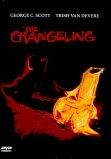
The Changeling (1980)


Director: Peter Medak
Writers: Russell Hunter, William Gray, Diana Maddox
Actors: George C. Scott, Trish Van Devere

Ready for a good ghost story? Furniture that moves on its own accord? Creepy old houses with nasty secrets? Then The Changeling is the movie for you! Not to be confused with the new Angelina Jolie flick, Changeling, The Changeling is a grand ghost flick that takes us on a ride with a grieving widower (Scott) who in an attempt to start his life over by moving to a new city and into an old mansion, finds himself in the center of a mystery. What happened in this house so long ago? Watch the movie if you want to find out, I love this stuff! George C. Scott is awesome as usual and plays a brooding widower well.

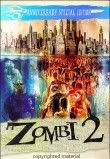
Zombie 2 (1979)


Director: Lucio Fulci
Writers: Elisa Briganti, Dardano Sacchetti
Actors: Ian McCulloch, Tisa Farrow, Richard Johnson

Watch Zombi 2 if for nothing more than to see the most amazing zombie versus shark scene ever to hit celluloid. Ok, it’s probably the only zombie versus shark scene to ever hit celluloid, but it is still marvelous. Zombi 2, otherwise known as Zombie, was meant to draw in Dawn of Dead fans but has no connection to Romero’s Dead films. It follows reporter Peter West (McCulloch) who travels to the island of Matool to investigate the origins of a boat full of corpses that appears in New York Harbor. He is accompanied by Anne (Farrow, sister of Mia) and together they discover that Matool has a little problem with, you guessed it, zombies! I think this is a great movie but be warned, it’s pretty gory, make that really gory. The only version of this flick is dubbed but it’s an Italian horror so the dubbing is done well.

Dead & Breakfast (2004)


Director: Matthew Leutwyler
Writers: Matthew Leutwyler, Jun Tan, Billy Burke
Actors: Ever Carradine, David Carradine

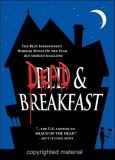
Yay, Dead & Breakfast! I think this is one of those movies that you think is awesome or you just don’t get. I of course, think it is awesome. I saw this in an independent theater with a couple of friends and the house had maybe 25 people in it but we laughed and laughed, it was a good old time. Dead & Breakfast is a silly, silly spoof of a zombie movie that is part comedy, part musical, part gorefest, and all fun. There are a ton of recognizable faces such as David Carradine, his niece Ever Carradine, Portia de Rossi, Jeremy Sisto, and even Brian Krakow from My So Called Life! If you like silliness, you might enjoy this one.

15 Reasons Not To Leave Your House: Part One

I bypassed the ratings for these films as they are more general recommendations than full reviews. I'm sure I will return to some of them at a later date for a more in-depth analysis. Enjoy!

Dagon (2001)

Director: Stuart Gordon
Writers: H. P. Lovecraft (short stories “Dagon” & “The Shadow Over Innsmouth”), Dennis Paoli (screenplay)
Actors: Ezra Godden, Raquel Merono, Francisco Rabal

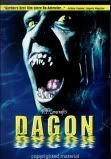
Dagon is a lesser known title brought to us by Re-Animator director Stuart Gordon. Young couple Paul (Godden) and Barbara (Merono) find themselves stranded in a small coastal town in Spain after a boating accident and it doesn’t take long for them to realize that all is not right, in fact it is very wrong. This is a fun, gothic, creepy, sometimes gory film and one of my favorite Gordon flicks.

To be clear, I think Dagon is lesser known for a reason, a lot of people just aren't into it. Had I rated it, I probably would have given it 2 1/2 black sheep but for some reason I really enjoy it and some of the gore effects are pretty cool (and I'm not talking about some of the CGI effects that I do NOT like in the movie). I think it's one of those movies that either grabs you or it doesn't, but it is worth the risk if you end up really liking it. I just really enjoy Stuart Gordon in general and this Lovecraft adaptation is probably the closest anyone has ever done.

Saam gang yi/3 Extremes (2004)

Directors: Fruit Chan, Chan-wook Park, Takashi Miike
Writers: Lilian Lee, Chan-wook Park, Haruko Fukushima, Bun Saikou
Actors: Bai Ling, Byung-hun Lee, Hye-jeong Kang, Kyoko Hasegawa, Atsuro Watabe

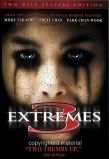
This collection of three short horror films from three different Asian directors is a must-see. They are all excellent but my personal favorites are the second and third entries, Cut and Box. Cut is directed by Chan-Wook Park (Oldboy) and is everything you could hope for from this Korean director. Takashi Miike is my favorite Japanese director and he does not disappoint with Box, a haunting and beautiful art film with a sweetly dark plot. Dumpling is pretty disturbing but good if you can handle the premise.

An American Werewolf in London (1981)


Director: John Landis
Writer: John Landis
Actors: David Naughton, Griffin Dunne, Jenny Agutter

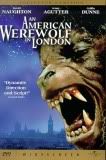
I love this movie! The average movie goer had a tough time with American Werewolf when it was first released as they weren’t used to such a mixture of horror and comedy. John Landis of Coming to America and Trading Places fame really hit this one out of the ballpark in my opinion. Two college buddies are backpacking through Europe when they are attacked by a werewolf, changing their lives forever. The Howling has long had the reputation for revolutionizing movie effects but it was released in the same year as American Werewolf and both films credit effects giant Rick Baker but Baker actually left The Howling to work on American Werewolf, leaving the bulk of The Howling effects to Rob Bottin. I’ve always thought the effects in American Werewolf were far superior and the initial transformation scene is fantastic, music, visuals and all.

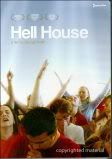
Hell House (2001)


Director: George Ratliff

Hell House is a documentary that features an annual haunted house hosted by Trinity Church in Cedar Hill, Texas. The house is extravagantly designed and includes live horror scenes being acted out by church members, covering themes such as abortion, homosexuality, AIDS, drug use, and adultery. Visitors are shown the many ways they might find themselves going to hell and are given a chance to find salvation in Jesus upon completion of the tour. The film is surprisingly unbiased in how it portrays the church and its followers, leaving it up to the viewer to make any judgments.

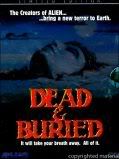
Dead & Buried (1981)


Director: Gary Sherman
Writers: Jeff Millar, Dan O’Bannon
Actors: James Farentino, Jack Albertson, Robert Englund

Dan Gillis (Farentino) is sheriff of Potter’s Bluff, a small, quiet coastal town where everyone knows their neighbor and life is simple… or is it? Sheriff Gillis finds himself dealing with an unusual number of deaths and Dobbs, the local undertaker, is obsessed with restoring the dead to their living form. Dead & Buried is a fantastic movie by the director of Vice Squad that has remained on the fringe despite the fact that it is rad! The master, Stan Winston, creates some amazingly realistic makeup effects that are seldom achieved even now, more than 25 years later. Note, however, that there are a couple of sequences that stand out as being far below Winston’s usual standard. This is because the studio that ended up distributing the film wanted more gore and as a result, scenes were added using a different effects artist… bad idea. Otherwise, great movie!